
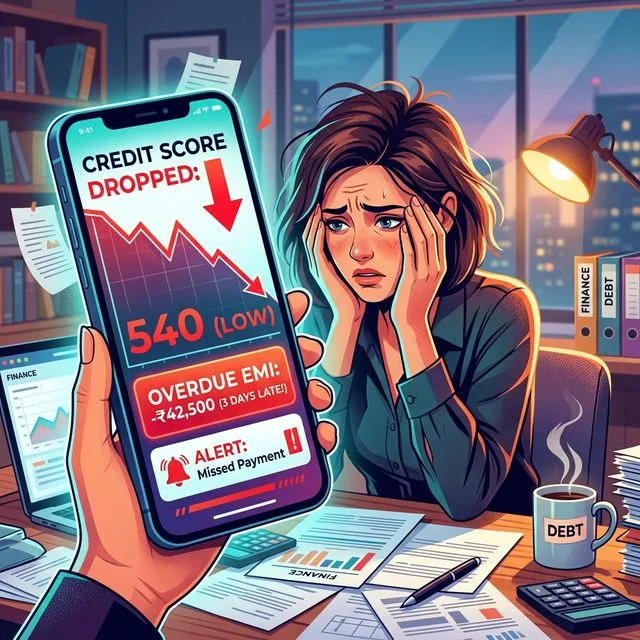
One missed EMI payment might feel like a small slip. But it can affect your credit score for months or even years.
Your credit score, often referred to as your CIBIL score in India, is one of the most important numbers in your financial life. It determines whether you get approved for loans, credit cards, and even rental agreements. And the fastest way to damage it is by missing EMI payments.
What Happens When You Miss an EMI
When an EMI due date passes without payment, a chain of events begins:
Within 1 to 30 days: The lender marks your account as overdue. You are charged a late payment fee. Most banks charge between 1 percent and 2 percent of the EMI amount or a flat penalty fee.
After 30 days: The lender reports the missed payment to credit bureaus like CIBIL, Experian, and Equifax. Your credit score drops. Even a single 30-day late payment can reduce your score by 50 to 100 points.
After 90 days: Your account may be classified as a Non-Performing Asset (NPA). This is a serious red flag on your credit report and makes future loan approvals extremely difficult.
After 180 days: The lender may initiate recovery proceedings or write off the loan. This stays on your credit report for up to seven years.
Why Even One Missed Payment Matters
Credit bureaus weigh payment history heavily. It typically accounts for 35 to 40 percent of your total credit score calculation.
This means:
- A person with an excellent score of 800 can drop to 700 or lower after a single missed payment
- The higher your score, the bigger the impact of a missed payment
- Recent missed payments hurt more than older ones
- Multiple missed payments across different loans compound the damage
A low credit score leads to higher interest rates on future loans, lower credit limits, and in some cases, outright rejection of applications.
The Hidden Costs Beyond Credit Score
Missing EMI payments creates a ripple effect beyond your credit report:
- Late payment fees add up quickly across multiple loans
- Penal interest is charged on the overdue amount at higher rates
- Loan restructuring costs if you need to renegotiate terms
- Stress and mental load from collection calls and payment pressure
- Lost negotiating power when applying for future financial products
Common Reasons People Miss EMI Payments
Most people do not miss payments intentionally. The common reasons include:
- Managing too many loans and losing track of due dates
- Forgetting which EMI is due on which date
- Insufficient balance on the auto-debit date
- Relying on memory instead of a tracking system
- Not accounting for subscriptions and recurring payments in monthly budgets
The pattern is clear. It is rarely about affordability. It is almost always about visibility and organization.
How to Protect Your Credit Score
The best way to avoid missed payments is to have complete visibility over all your financial obligations. Here is a practical approach:
Track Every EMI in One Place
Stop relying on scattered bank messages and calendar reminders. Use a dedicated EMI tracker that shows all your loans, due dates, and outstanding balances in a single dashboard.
Know Your Monthly Outflow
Add up all EMIs, subscriptions, and recurring payments. Compare this against your monthly income. Financial advisors recommend keeping total EMI obligations below 40 percent of your monthly income.
Set Up Early Warnings
Do not wait for the due date to remember a payment. Get alerts a few days before each EMI is due so you can ensure sufficient balance in your account.
Review Monthly
Spend five minutes each month reviewing your EMI status. Check which payments are on track, which are due soon, and whether any loans are nearing completion.
A Simple Tool for EMI Management
EMI and Subscriptions Tracker is designed to solve exactly this problem. It gives you:
- A clear dashboard showing all active EMIs and their status
- Upcoming payment dates and amounts at a glance
- Tracking for both bank EMIs and credit card EMIs
- A built-in EMI calculator to evaluate new loans before committing
- Subscription tracking to capture every recurring payment
- Clean, ad-free experience with no unnecessary permissions
Instead of juggling bank apps and spreadsheets, you get one place to see everything you owe and when it is due.
Start Before the Next Due Date
Your credit score is built one payment at a time. Every on-time EMI strengthens it. Every missed payment weakens it.
The difference between financial stress and financial confidence often comes down to one thing: knowing what is due and when.
Download EMI and Subscriptions Tracker
- Play Store: EMI Tracker on Google Play
- App Store: EMI Tracker on Apple App Store